



With help from the Wayback Machine, we’ve pulled together a selection of snapshots to show the journey we’ve taken over the years. From our earliest static pages to the dynamic, modern platform we have today, the journey of our online presence tells a story of innovation, resilience, and continual improvement. As we celebrate this anniversary, we thought it would be fun to take a look back at how our website has evolved over the years.
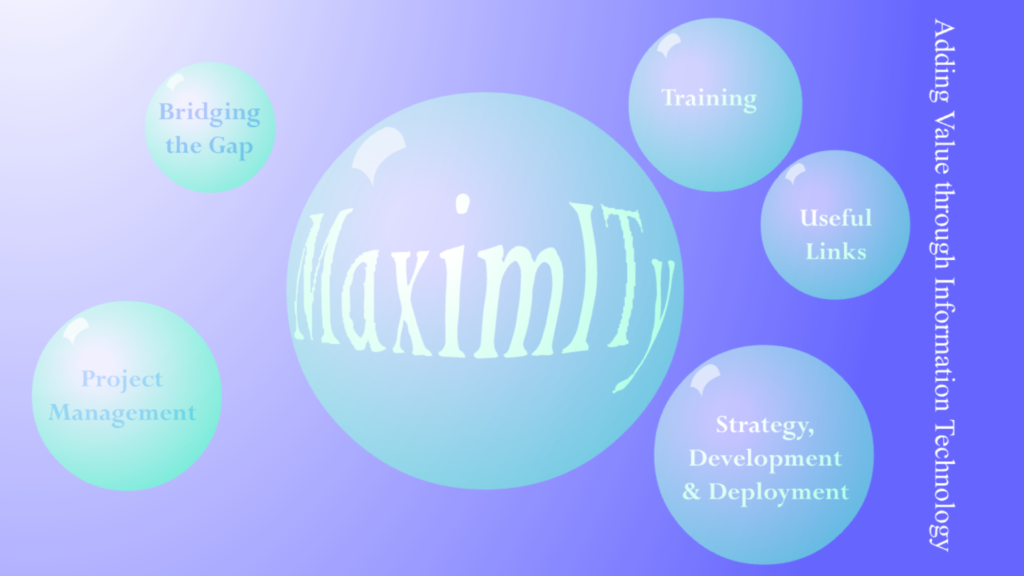
Our earliest website featured bubbles and a bold mission. With the tagline “Adding Value through Information Technology”, it reflected our ambition to make a meaningful impact. The design was typical of its time with pastel gradients and floating shapes, but even then, the focus was on clarity and service delivery.
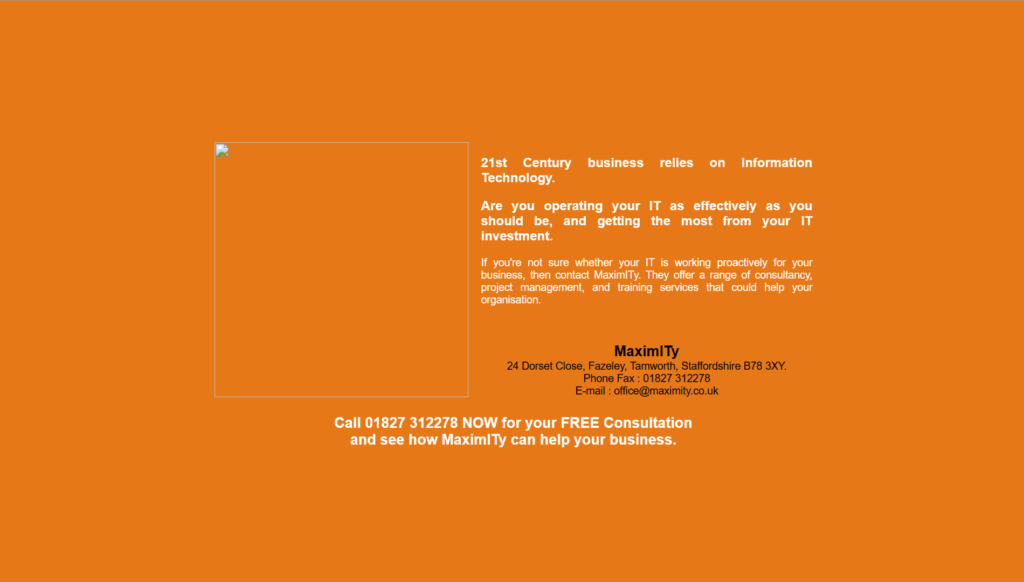
By 2005, our design had shifted to a striking orange palette and a more direct message. The content centred around helping businesses maximise their IT investment, a theme that remains core to our work today. The messaging focused on driving business improvement through IT, with a more structured layout and clearer calls to action. Notably, you could still contact us via fax…
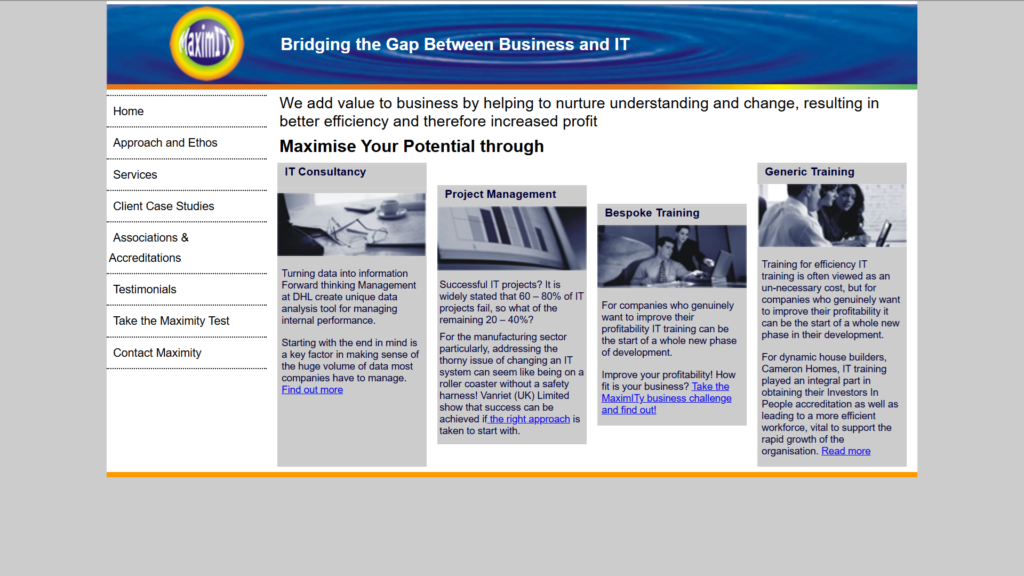
This update brought a more corporate look, with a structured layout, blue tones, and a clear focus on bridging the gap between business and IT. It included client case studies, accreditation badges, and even a “Maximity Test” challenge, all aimed at reinforcing credibility and showcasing our expertise.
This version introduced a more polished and professional Maximity, with a focus on client partnerships, lifelong learning, and strategic project delivery. It marked the first appearance of the Maximity logo that continues to evolve today. We also proudly promoted our PRINCE2 project management services, backed by Tracy’s official accreditation. Fittingly, the homepage featured a photo of her delivering a training session.
This version introduced a cleaner, more contemporary design with softer branding and a renewed focus on clarity. The layout featured rounded boxes that echoed the shape of our logo, creating a cohesive visual identity across the site. The messaging was clear and customer-focused, reflecting our goal to make IT less stressful and more accessible. From meeting room hire to project management, the website presented our services in a structured, user-friendly way.
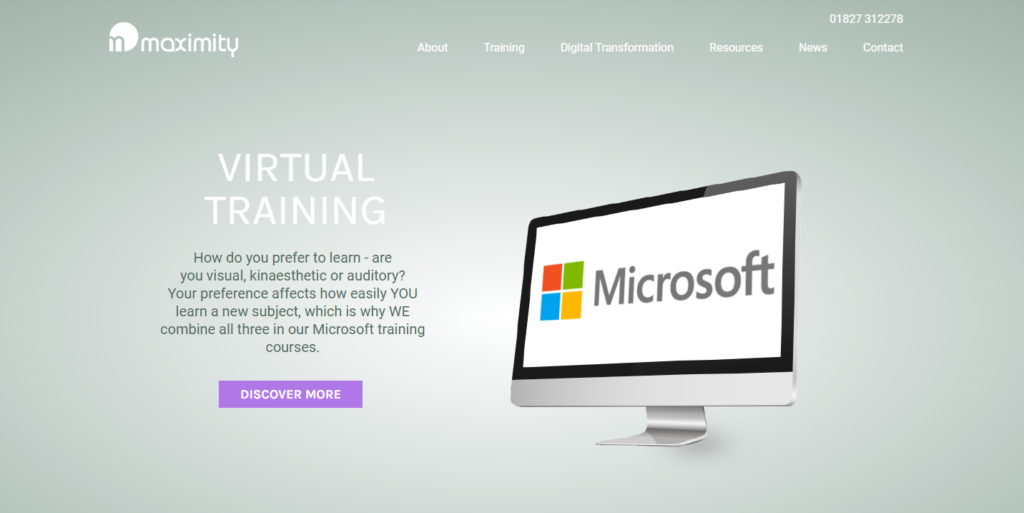
As the world shifted online, so did we. With a fresh and minimalist design, we focused on virtual training tailored to how each person learns best. Whether someone prefers visual, kinaesthetic or auditory learning, we combined all three to make our remote Microsoft training more engaging and accessible.
In 2021, we embraced a more minimalist look. Clean lines, spacious layouts and a focus on clarity gave our website a fresh visual identity. Rather than losing personality, this refined style helped us deliver our message more effectively. We focused on fun, immersive training and nationwide consultancy to help businesses thrive in a fast moving digital world. This sleek and contemporary approach continued through 2022, with subtle updates to colour and tone that made the site feel even more welcoming and engaging.
In 2023, we completely redesigned our website to reflect who we are today. We introduced a vibrant new look with a dynamic tone that shows our team’s passion and expertise. One of the highlights is our interactive word cloud, built using HTML, CSS and JavaScript. It brings together everything we do best, including Business Central, Microsoft 365, training, cyber safety and consultancy. It is a visual celebration of the skills and services we offer and the businesses we support every day.
Each version of our website tells a story of the time, the tech, and the team behind it. Today, we stand proud of where we’ve been and even more excited about where we’re going!

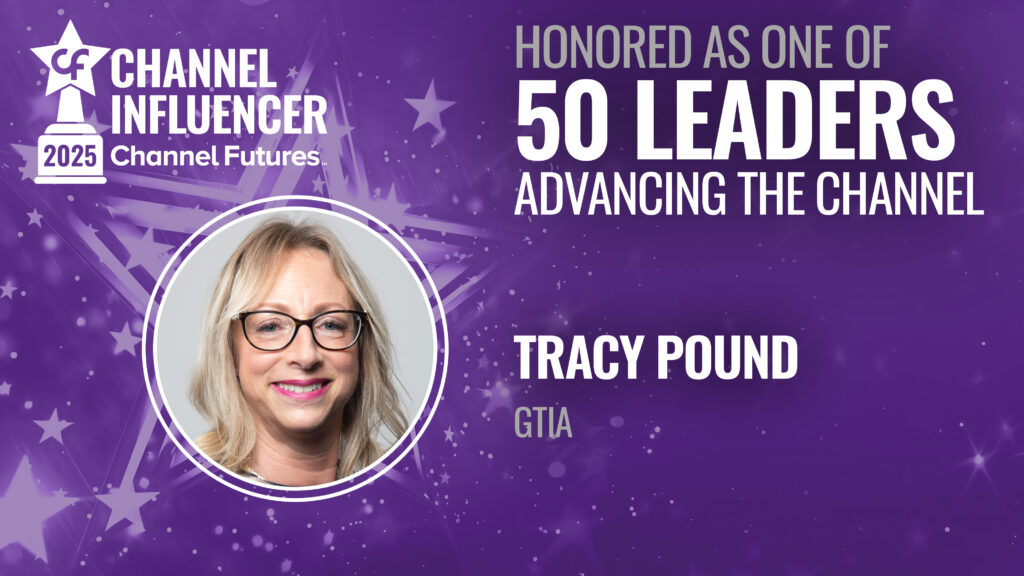
Tracy is one of 50 individuals recognised by the editors of Channel Futures as a thought leader who has impacted the direction of the IT and communications indirect sales channel in the past year. She is profiled on Channel Futures and in a special digital issue that can be downloaded from the website.
Since 2018, the Channel Futures Channel Influencer Awards have recognised the 50 top-performing executives in the information technology and communications channel. Channel Futures Channel Influencers are a cross-section of industry leaders who have had the biggest impact on their organisations and on the channel overall. From technology advisors to managed service providers, vendor and distributor execs, analysts and more, these senior leaders represent the future of the channel. We recognise them as the year’s highest achievers in strategic thinking and innovation in the indirect sales channel. Among the 50 executives honoured, Channel Futures recognises two Influencers from the list who we consider to be the year’s most influential.
Previous Influencer of the Year honourees, now in the Channel Futures Channel Influencer Hall of Fame, are:
The 2025 Channel Influencers join an illustrious group that has left an indelible mark on the entire technology channel, impacting the way today’s most innovative IT and connectivity solutions go to market, are sold, delivered to customers and supported. These executives selected by Channel Futures have distinguished themselves through their unwavering support of the partner community, forging deep and trusted relationships across the ecosystem. In selecting this year’s Influencers, Channel Futures’ editors considered the organisation’s partner growth, channel innovation and the individual’s commitment to the indirect sales channel, along with the standing each person has among their peers.
“Channel Futures is proud to identify a whole new class of movers and shakers who are having a profound impact on the way the channel does business,” said Craig Galbraith, editorial director for Channel Futures. “As the majority of businesses seeking technology solutions rely on channel partners to help them evolve and grow, the Influencers on this list are at the core of the industry today.”
Channel Futures, part of Informa TechTarget, is the premier destination for the information technology and communications industry. We provide news and information, analysis and connection for the entire channel ecosystem, including solution providers (SPs), managed service providers (MSPs), managed security service providers (MSSPs), cloud service providers (CSPs), value-added resellers (VARs) and distributors, technology services distributors (TSDs) and technology advisors (agents), as well as leading technology vendor partners and communication providers.
We are the home of the MSP 501 list, a ranking of the most influential and fastest-growing providers of managed services in the technology industry, and we are the official media sponsor of Channel Partners events, including the Channel Partners Conference & Expo − the world’s largest independent channel event − and the MSP Summit. Channel Futures is where the world meets the channel.
If a cybercriminal set their sights on your business today, how much time do you think it would take for them to trick an unsuspecting employee into handing over sensitive information?
The truth is, human error remains one of the weakest links in cybersecurity. It’s estimated that 88% of data breaches are caused by an employee mistake. With user-targeted attacks becoming more frequent and sophisticated each year, it’s more important than ever for businesses to understand where their human security vulnerabilities are—before an attacker can exploit them.
That’s why we’ve launched a new Human Risk Report service to help you shine a light on your high-risk areas—and it’s completely free.
When thinking about cybersecurity, most organisations focus on technical defences like firewalls and encryption. However, no matter how strong your technical protections are, they can be undone by a single, simple human error—such as clicking a phishing link or falling for a clever social engineering scam.
The stakes are high. Phishing attacks, for example, have evolved significantly, often designed to mimic legitimate communications or target individuals based on publicly available information. So, how well-prepared are your employees to spot these increasingly sophisticated threats?
If you don’t know the answer to this question, you’re not alone. That’s why understanding your organisation’s human security posture is critical, and our free Human Risk Report can help you do exactly that.
As part of our free Human Risk Report (HRR) service, we’ll help you understand your organisation’s human security posture against a number of key threats in just a few steps and with minimal effort. This includes identifying:
We’ll also calculate your organisation’s overall Human Risk Score, giving you a clear picture of how vulnerable your business may be to user-targeted attacks.
When a breach occurs, the consequences go far beyond financial losses. There’s the damage to your organisation’s reputation, the potential loss of customer trust, and the disruption to your operations. According to recent studies, it takes the average business over 200 days to detect a data breach—plenty of time for hackers to exfiltrate data and cause long-term damage.
Understanding your human risk isn’t just a nice-to-have; it’s essential to protecting your business from costly breaches and safeguarding your employees from being unwitting participants in a cyber attack.
The Human Risk Report will provide you with detailed insights into where your organisation is most vulnerable, but it doesn’t stop there. Included in your free report is a tailored step-by-step action plan, outlining the practical steps your business can take to address and reduce its human risk.
You’ll also have the opportunity to take advantage of a free trial of our Human Risk Management (HRM) service, which provides ongoing training and monitoring to keep your team safe from evolving threats.
Cybercriminals aren’t waiting, and neither should you. Knowing your weak spots today could save your business tomorrow.
To claim your free Human Risk Report (HRR), fill in the form on this page https://maximity.co.uk/cybersafety/ and we’ll start analysing your business for vulnerabilities.
Employees have long been viewed as the ‘weakest link’ in a business’s cyber security chain and, with human error still being the number one cause of data breaches, that unwanted title can still be applied to many businesses today.
In this article, we’ll guide you through the different types of insider threats within your business and the key reasons why businesses suffer a user-related data breach.
Oh, and we’ll also give you some advice on mitigating all of the above!
According to Verizon’s Data Breach Investigation Report (DBIR), over 85% of data breaches involve the ‘human element’. A common misconception here is that all user-related data breaches are caused by simple negligence – e.g. clicking on a phishing email.
The fact is, although negligence plays a huge role in most user-related data breaches, a big portion of these breaches are caused by additional or completely separate factors.
These types of users can be defined as those who commit acts like copying the wrong person into an email, attaching the wrong file to an email or clicking on a malicious phishing link.
These types of users are less common but are even more at risk than solely negligent users. That’s because these employees have credentials – such as usernames and passwords – that are exposed on the dark web. These exposed credentials are often used by attackers to launch hyper-targeted campaigns that appear to be much more legitimate than the traditional mass-mail phishing attacks.
Most employees never show malicious intent towards the business but, unfortunately, there are a few that do. These malicious motivations often involve a disgruntled current or ex-employee downloading sensitive company information – often to sell on to a competitor or to leverage in a new job/business venture.
From misdirecting an email to attaching the wrong file, every employee makes mistakes from time to time. In fact, 43% of employees say they’ve made a mistake at work that compromised cyber security. The issue is, these types of seemingly minor mistakes can result in sensitive data making it into the hands of a cyber criminal or onto the dark web, which can then be leveraged in a targeted attack.
A surprising amount of information about your business can be found online, including your suppliers, contractors, and customers. This makes it easy for attackers to impersonate internal and external contacts, and all it takes is for one person to be successfully duped for your business to be at risk.
The most common technique that attackers use to target employees is phishing. These types of attacks have evolved in the past few years, relying less on tricking users through generic ‘send-to-all’ email scams and focusing more on ‘spear phishing attacks’, using prior research to target and dupe a target.
People in any business are capable of breaking the rules, be it maliciously or accidentally. But a large portion of rule-breaking ventures further than not abiding by password policies – some employees can go as far as to steal corporate data and sell this on the dark web.
Most cases, however, are less malicious and mainly revolve around staff looking to cut corners – like sharing their password with a colleague so that there isn’t the need to create a separate account for a service.
To solve their human cybersecurity problem, many businesses look to launch annual or quarterly security awareness measures – like a once-per-year workshop for all staff.
The problem is, these sessions are often too infrequent and unengaging for employees to actually soak up the information and apply it to their everyday work life. Regular, short and engaging training is needed in order for employees to be well-versed on the latest threats, whilst not forgetting the best practices they’ve learned before.
Human Risk Management (HRM) is the modern approach to building a security-savvy workforce without hindering employee productivity.
Through our fully managed HRM service, you’re able to understand and reduce human cyber risk over time through regular security awareness training, periodic phishing simulations, dark web monitoring and simplified policy processes.
To celebrate the launch of our HRM service, we’re giving you the opportunity to calculate your human cyber risk with a free Human Risk Report (HRR).
Through a few steps, we’ll calculate the human risk score of your business and provide you with a clear action plan for strengthening at-risk areas.
To claim your free Human Risk Report (HRR), fill in the form on this page https://maximity.co.uk/cybersafety/ and we’ll start analysing your business for vulnerabilities.

With Verizon reporting that the ‘human element’ plays a part in 85% of cyber security breaches, your business can be compromised by just one well-crafted and well-researched phishing email landing in an employee’s inbox.
The fact is, common attacks like phishing have rapidly evolved over the past few years, and businesses have been slow to put in place effective measures for combatting the growing risks – resulting in more breaches, costly financial hits and damaging data losses.
That’s why we’ve launched a brand new service that reduces employee human error and gives staff the knowledge to combat evolving cyber threats.
With user-targeted attacks seeing a huge increase in the past couple of years, not least due to the rapid switch of staff working from home, sophisticated attacks like phishing and business email compromise have surged.
That’s why we now offer a new comprehensive solution for helping your business measure, reduce and monitor human cyber risk – without hindering employee productivity or draining internal time or money.
With our new managed Human Risk Management (HRM) service, you’re able to:
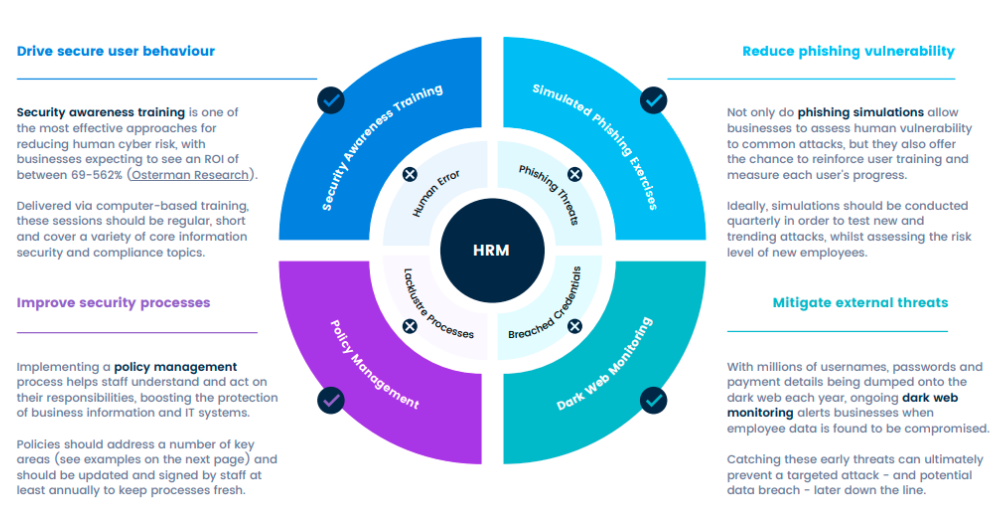
Human Risk Management (HRM) combines the key elements needed to build a security-savvy culture against evolving cyber threats. It does this by combining:
To celebrate the launch of our new service, we’re giving you the opportunity to calculate your human cyber risk with a free Human Risk Report (HRR).
Through a few steps, we’ll calculate the human risk score of your business and provide you with a clear action plan for strengthening at-risk areas.
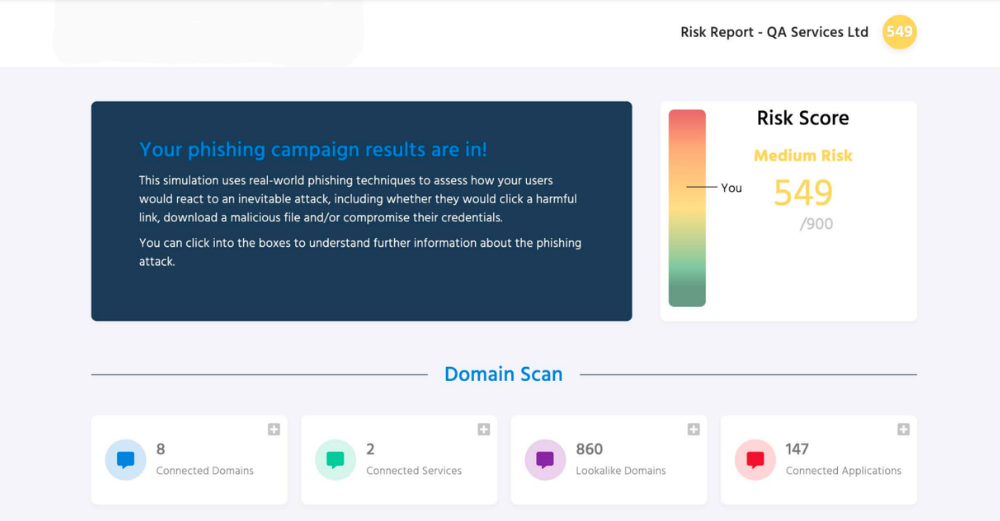
To claim your free Human Risk Report (HRR), fill in the form on this page https://maximity.co.uk/cybersafety/ and we’ll start analysing your business for vulnerabilities.


To provide the best experiences, we use technologies like cookies to store and/or access device information. Consenting to these technologies will allow us to process data such as browsing behaviour or unique IDs on this site. Not consenting or withdrawing consent, may adversely affect certain features and functions.


